- Home
- Research and Informed Policy
- The Social Impact of Circular Strategies in the Apparel Value Chain
The Social Impact of Circular Strategies in the Apparel Value Chain
The Social Impact of Circular Strategies in the Apparel Value Chain (2020–2024) was a four-year international research collaboration led by Utrecht University, with Conserve India leading the India chapter. Conducted across India, the Netherlands, and Spain, the project explored how circular economy models in textiles can promote not only environmental sustainability but also job quality, gender inclusion, and social equity. Conserve India developed and piloted the Social Impact Assessment Framework for Circular Economy (SIAF-CE) and its gender-inclusive version, engaging 92 Indian MSMEs to test practical tools for aligning circular practices with social outcomes. The initiative produced policy briefs, research publications, and business pilots, offering actionable insights for building just, inclusive, and sustainable textile value chains.
Funding organisation: Utrecht University
Partner organisations: Laudes Foundation,
Implementing organisations: Conserve India,
A Global Research Collaboration for a Just, Inclusive, and Circular Textile Future (2020–2024)
What we did
From 2020 to 2024, Conserve India served as the India lead in a major international research collaboration led by Utrecht University (Netherlands), in partnership with the Export Promotion Council for Handicrafts (EPCH) and supported by the Laudes Foundation. Conducted across India, Spain, and the Netherlands, the project focused on assessing the social dimensions of circular economy strategies in the textile and apparel value chain.
In India, Conserve engaged deeply with MSMEs, artisans, and supply chain actors, using a combination of top-down and bottom-up methodologies to examine how circular models can deliver not just environmental benefits, but also support job quality, gender equity, and inclusive livelihoods. Through field research, enterprise engagement, and policy dialogue, the project generated actionable frameworks and tools to align circular economy efforts with social justice.
Why It Matters
While circular economy models are widely recognized for their environmental promise, their social implications remain underexplored. For countries like India—home to millions of informal workers and small textile enterprises—circular transitions must address equity, labor dignity, gender inclusion, and economic justice. This research offered a vital corrective by centering the people behind the processes, ensuring that circularity is not only sustainable but also just and inclusive.
Outcomes
- Developed two ground-breaking frameworks: SIAF-CE and SIAF-CE⚥
- Engaged 92 Indian textile enterprises in pilot studies
- Produced three key publications and policy briefs
- Piloted business-oriented circular-social alignment tools
- Highlighted global relevance of gender inclusion, labor dignity, and livelihood resilience
- Initiated the development of digital tools to scale adoption
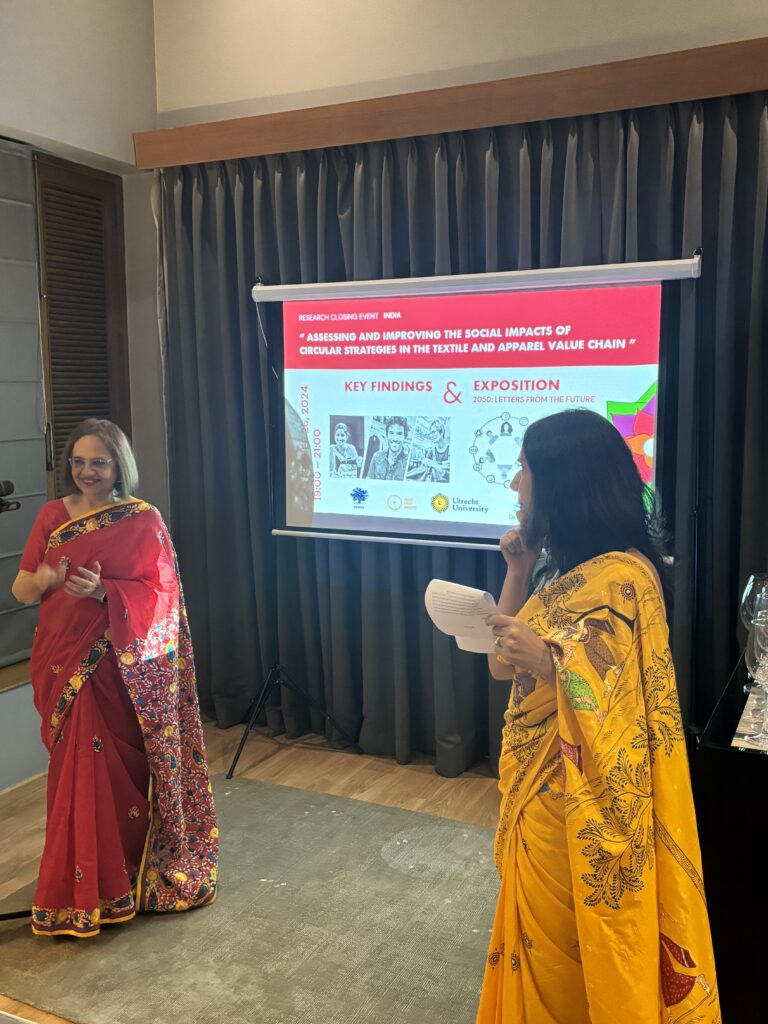
The project culminated in a closing event in September 2024, featuring keynote remarks by Mr. Bernd Scholtz, Chief Economic Counsellor, Embassy of the Kingdom of the Netherlands in India. Exhibits such as “Letters from the Future” and “Recycling Post-Consumer Woollen Waste” were showcased to illustrate community visions for a socially just circular future.
This four-year collaboration demonstrated that a circular economy must go beyond environmental metrics—it must prioritize equity, inclusion, and dignity. By fusing grounded research with international expertise, the project laid the foundation for a future where circularity and social justice go hand in hand in the global textile sector.
Click here to read our policy brief: Policy Brief.pdf
Our Partners